An antiaging claim can describe several different goals: a change that someone sees, a change detected in a tissue sample, or a change in how skin functions. These goals should not be treated as interchangeable simply because they appear in the same discussion. An appearance measure may answer a worthwhile question on its own. A functional claim needs a measurement that actually addresses the proposed function.
This guide examines the reasoning needed to move from a research result to a meaningful conclusion. The emphasis is on the definition of benefit: which outcome was measured, whose observations entered the calculation, and whether the size of a change can be interpreted beyond the scale itself. Original hypothetical examples illustrate the arithmetic without introducing additional clinical results. They help separate a defensible reading of evidence from a larger promise that would need another investigation.
Study figure and data
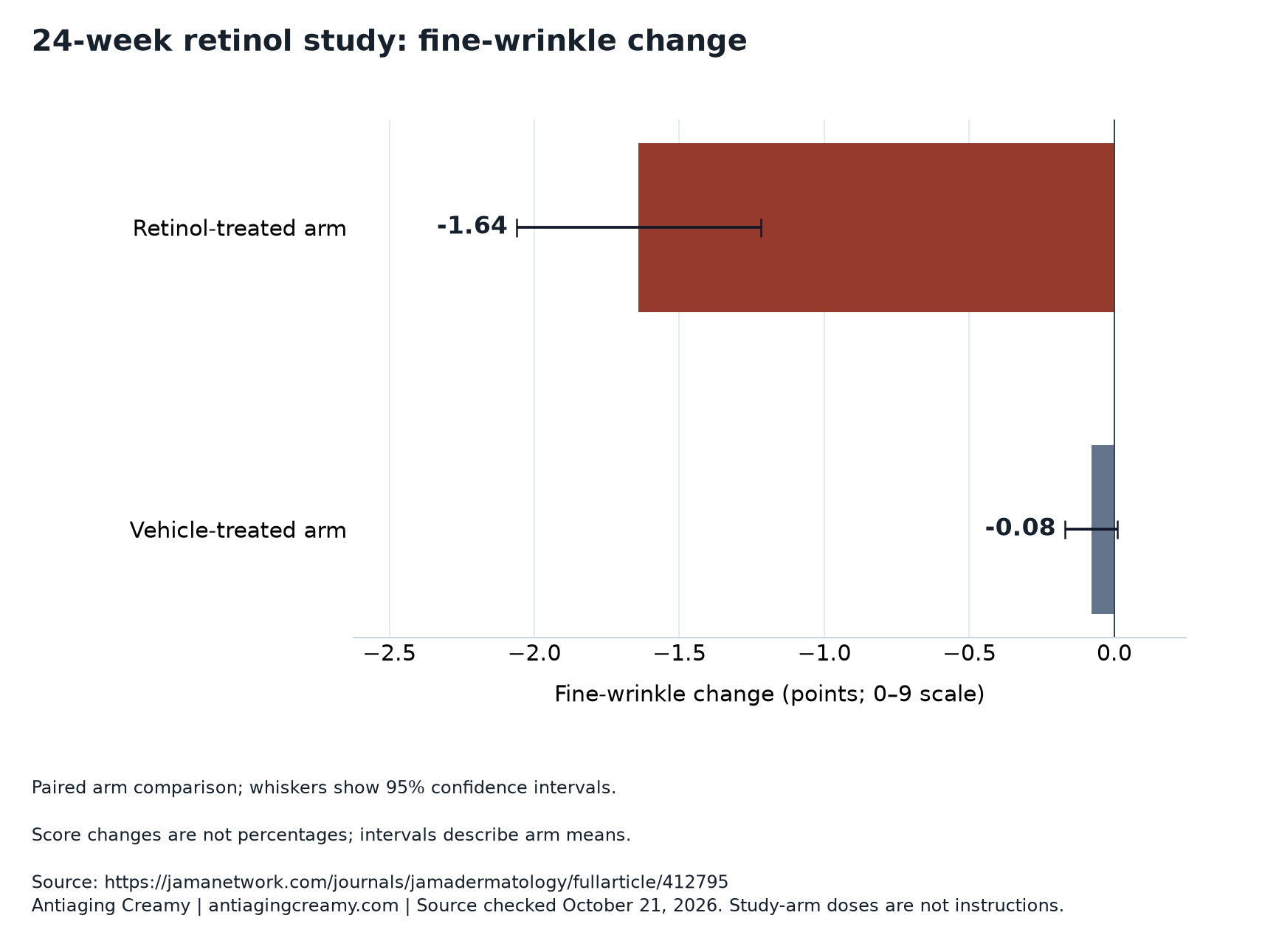
Paired arm comparison; whiskers show 95% confidence intervals.
Score changes are not percentages; intervals describe arm means.
Download source-labeled chart (PNG)Download chart data (CSV)Download vector chart (SVG)
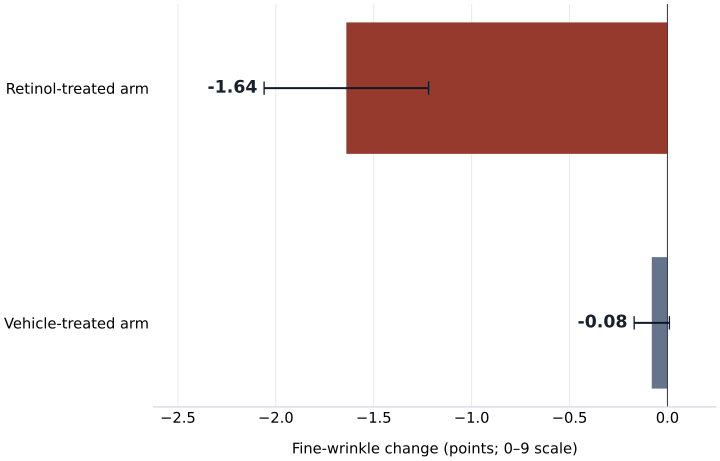
| Study group | Reported value | 95% confidence interval |
|---|---|---|
| Retinol-treated arm | -1.64 | -2.06 to -1.22 |
| Vehicle-treated arm | -0.08 | -0.17 to 0.01 |
Sections in this article
Define benefit before interpreting improvement
A useful claim begins with an outcome that could be observed consistently. An appearance rating asks an observer to judge a visible feature using a stated rule. A tissue measurement asks a laboratory question about the sampled material. A functional outcome asks whether something people care about actually happens, such as a specified change in comfort or a clinical event. Each requires a suitable method of observation.
These categories do not form a simple ranking from weak to strong. The right endpoint depends on the question. A carefully assessed appearance outcome is relevant to an appearance claim. It becomes insufficient when the claim expands to a different kind of benefit without additional evidence. The problem is the unsupported change in meaning, rather than the mere use of a rating scale.
Our guide to reading skincare claims offers a practical starting point. Before examining a promising number, rewrite the claim as a sentence with a named outcome, comparison and observation period. Then ask what would count as success and what would count as a disappointing result. If either remains unclear, the wording may be too broad for the cited measurement to answer.
| Outcome type | Question it can address | Additional claim requiring separate evidence |
|---|---|---|
| Appearance rating | Did an assessed feature change on a defined scale? | A particular change in comfort or daily experience |
| Tissue measurement | Did a specified laboratory measure differ? | A causal explanation for a clinical benefit |
| Functional or event outcome | Did the defined function or event change? | Benefits outside that measured function or event |
| Participant assessment | How did participants evaluate their experience? | An observer-independent physical measurement |
A comparison gives the outcome its context
A favorable before-and-after change leaves an important question unanswered: what would have happened under the alternative condition? A control is the study’s attempt to make that question observable. The relevant contrast depends on the chosen alternative. Comparing with a vehicle, comparing with another active preparation and comparing with no intervention are different designs, not different names for the same result.
In a paired-site design, each person contributes information under both conditions. The paired observations share an individual and should not be analyzed as if they came from separately recruited people. That linkage can make the within-person comparison useful while leaving other questions open. For example, a convincing contrast within a study does not establish that the same magnitude applies to a different population or anatomical location.
The study-reading checklist can also be used as a general editorial exercise: identify the comparator, the unit of observation and the target population before interpreting the headline. Random assignment concerns how conditions are allocated; it does not make a recruited sample representative of every intended reader. Generalization needs its own argument, and a mismatch should be described as an uncertainty rather than converted into an invented adjustment to the result.
A score change needs units and a meaningful reference
The units of a scale tell us what arithmetic is legitimate, but not necessarily what the result means in daily life. A change in a severity rating can be expressed in points. That does not turn the score into a count of wrinkles, an area of skin or an estimate of years reversed. Those interpretations would need a demonstrated connection to the measurement.
Consider a wholly invented scale on which a value falls from twelve to nine. The decrease is three points, or one quarter of the initial numerical score. It would be wrong to relabel that calculation as one quarter of wrinkles removed unless the instrument actually counted wrinkles and the relevant comparison supported that statement. The arithmetic is straightforward; the error occurs when the meaning of the denominator changes.
A reader also needs a reference for importance. Is the difference large enough to be noticeable or worthwhile according to a suitable, prospectively chosen criterion? Without that reference, a statistically detectable movement should remain a scale movement. Our companion analysis of concentration and irritation considers another interpretation problem: a reported similarity and a formal test of equivalence are not the same conclusion. Both examples show why the question must be defined before the number is given a broader meaning.
Precision is different from personal predictability
A group estimate summarizes information across observations. Its confidence interval concerns uncertainty about that estimated quantity under the analysis assumptions. It should not be read as the range of outcomes that a particular proportion of future users will experience. A study can estimate an average with some precision while individual experiences remain variable or insufficiently characterized.
Standard errors and confidence intervals also serve different purposes. A standard error estimates the variability of an estimator; an interval uses a method to express uncertainty around an estimate. The visual length of a plotted bar is not interpretable until the caption identifies the quantity represented. Comparing two figures without checking their analysis populations can compound that problem.
For paired observations, estimating uncertainty about a treatment difference requires information about how the two measurements relate within people. Simply subtracting the extremes of separate intervals does not recover a valid interval for that contrast. This is one reason our retinoid comparison guide should be read as a guide to questions rather than a personal response calculator. Neither a printed concentration nor an uncertainty bar can supply an individualized forecast without the appropriate evidence and clinical context.
Exposure and unavailable observations change the reading
Staff applications averaged 1.6 weekly (planned ≤3); irritation prompted withholding.
The intervention described in a protocol and the exposure people actually receive are different pieces of information. When tolerability changes exposure, the result reflects that experience rather than a hypothetical uninterrupted course. A retrospective comparison of people receiving more and fewer applications would also mix exposure with the reasons they received different amounts. It would not automatically establish the best schedule.
Missing follow-up creates a related problem. Intent-to-treat aims to retain assigned participants in the comparison. Last observation carried forward substitutes a previous observation for a later unavailable one; it does not convert the missing measurement into an observed measurement. In an illustrative case, someone’s earlier score might be carried into the final analysis even though the unobserved final value could have improved or worsened. An analysis restricted to completers instead changes which people contribute. The useful scientific question is how the conclusion behaves under plausible alternative assumptions. Neither a familiar analysis label nor a larger-looking denominator removes the need to examine those assumptions.
Tissue signals and functional claims require a connecting test
Only significant biopsy findings were reported: glycosaminoglycans n=6, procollagen I n=4. Injury/ulcer protection remained hypothetical.
A tissue signal can suggest a mechanism worth investigating. It does not by itself demonstrate that a change in that signal caused an appearance outcome, nor that it produces a different clinical benefit. Two measurements can move together for several reasons. To establish a causal explanation, researchers need evidence suited to the proposed pathway, including how competing explanations and the timing of changes are addressed.
Selective reporting adds another layer of uncertainty. If readers see only tests that pass a significance threshold, they cannot assess the whole set of measurements from those selected results alone. The number of tests, the way they were chosen and the completeness of reporting matter. For a functional claim, a future study would need to define the function or event directly, collect it systematically, and include a credible comparison. A plausible biological narrative can justify doing that work. It cannot substitute for observing the outcome that the narrative predicts.
Clinical importance should be specified before counting responders
A threshold can translate a continuous scale into a responder definition, but its choice matters. Researchers should explain why the threshold represents a worthwhile change and whether it was selected before examining the results. Choosing the cutoff afterward because it produces the most favorable comparison makes the resulting percentage harder to interpret.
Imagine an entirely hypothetical future trial that defines response as a change of at least three points on its chosen instrument. A person improving by two points would be classified differently from someone improving by three, even if their experiences felt similar. The responder percentage would answer a threshold-specific question. It would not replace the full distribution of changes, the uncertainty of the comparison or a direct assessment of how participants valued their results.
Importance also depends on burden. A participant might value a modest visible change differently depending on discomfort, inconvenience or the effort required to continue. A sound research plan can collect those dimensions separately instead of hiding them inside one favorable adjective. This is an original proposal for interpreting future evidence, not a claimed result from the reports discussed here. Clear definitions make it possible to discuss benefit and burden without inventing a universal standard of satisfaction.
Related studies offer context without supplying missing endpoints
The 1995 abstract describes 99 completers over 48 weeks comparing tretinoin 0.1%, 0.025% and vehicle; the higher strength produced more erythema and scaling. The 2005 randomized report involved 204 participants, 0.05% tretinoin emollient cream and vehicle over up to two years. Its abstract reports improvements in facial photodamage but supplies no numerical effect estimates or confidence intervals.
Different reports can help refine a scientific question, especially when they use different durations or outcome measures. They should not be combined into an informal ranking simply because they concern related ingredients. To compare effects credibly, an analyst must consider the populations, preparations, scales, follow-up and handling of missing information. Similar terminology does not guarantee a common measurement.
Likewise, a longer investigation does not retrospectively add an unmeasured outcome to another experiment. Duration, precision and relevance are separate features. A careful synthesis identifies what each source contributes and leaves unresolved questions visible. The table below keeps the documents separate so that a finding about one preparation is not quietly promoted into a broader statement about every antiaging cream or every type of skin benefit.
| Record | Access used here | Reading priority |
|---|---|---|
| 1995 tretinoin concentration report | Indexed primary abstract | Keep efficacy comparisons distinct from irritation findings. |
| 2005 longer-duration tretinoin report | Indexed primary abstract | Look separately at follow-up, outcome magnitude and uncertainty. |
| RENOVA 0.02% cream labeling | Current official label | Respect the exact product, indication and stated limitations. |
Tolerability, labels and interests should remain visible
Four investigators disclosed conditional patent royalties; that disclosure does not establish study funding or payments. Financial context belongs alongside the methods and results, while remaining a distinct question. Readers should be able to inspect a documented relationship without being asked to infer either misconduct or freedom from bias from that relationship alone.
RENOVA 0.02% labeling addresses adjunctive mitigation of fine facial wrinkles with comprehensive skincare and sunlight avoidance, not wrinkle elimination or repair of sun-damaged skin. Safety and effectiveness beyond 52 weeks or above age 71 are not established. The label says not to use it during pregnancy or when attempting pregnancy. These limits apply to that exact tretinoin cream.
Our guide to prescription and compounded product labels helps frame the documentary distinction. A research report describes an investigation; a product label addresses a particular medicine. Neither should be silently substituted for the other. When evaluating tolerability, keep symptom counts, severity, treatment interruptions and withdrawal separate. One person may report several symptoms, and a percentage requires the correct denominator. A complete benefit assessment should not discard those distinctions merely because an efficacy endpoint appears favorable.
Turn a broad promise into an answerable question
A useful appraisal finishes with a specific account of what would reduce uncertainty. If a claim concerns appearance, identify the assessed feature and an interpretable size of change. If it concerns comfort or function, identify a direct measurement of that experience or function. If it concerns durability, specify the observation period and which participants remain under follow-up. The next research step then becomes concrete rather than a general request for more evidence.
The Curology brand review and Dermatica brand review are places to examine documentary terms around an offer. These links do not connect either business to the experimental preparation or establish outcomes for its products. Our editorial interpretation is that clinical meaning and purchasing conditions should remain separately checkable. A clear cancellation term cannot establish a skin benefit, just as a clinical signal cannot establish the quality of a service.
Before accepting an antiaging promise, ask whether the outcome in the sentence is the outcome in the evidence. Then check whether the comparison, population, timing and uncertainty still match. A result can remain interesting and useful after its scope is narrowed. Keeping that scope explicit is what allows readers to distinguish measured improvement, a mechanism proposed for investigation and an important benefit that has yet to be demonstrated.
Questions about the evidence
Does a visible improvement automatically mean skin functions better?
No such connection should be assumed. Appearance and function can be different outcomes, requiring different observations. To evaluate a functional claim, identify the exact function being proposed and whether the study measured it directly with an appropriate comparison. A visually meaningful result can still be useful without being expanded into a separate clinical promise.
How should I interpret a percentage calculated from a rating score?
First identify its denominator. A percentage change in a numerical rating remains a calculation about that rating; it is not automatically a percentage of physical wrinkles removed or people helped. An understandable report keeps the original units available and explains any conversion. The clinical interpretation then depends on evidence connecting the scale to the outcome that matters.
What makes a responder threshold informative?
The threshold needs a defensible meaning and a transparent reason for being chosen. Ideally, the research plan defines it before examining outcomes and reports the distribution of changes as well. A responder percentage can then answer a clear question, instead of disguising an arbitrary cutoff or replacing information about how much participants improved.
Can a laboratory result establish the mechanism of a cosmetic change?
It can contribute to a mechanistic investigation, but the causal connection needs its own support. Correlated changes do not automatically show that one caused the other. The appropriate next analysis depends on the proposed pathway and the design of the study. Laboratory plausibility is a reason to investigate an explanation, rather than permission to treat it as settled.
Why examine missing data when a study reports an average?
An average depends on which observations enter its calculation. Filling missing values using assumptions and restricting analysis to complete observations can address different questions or introduce different uncertainties. Readers should identify the approach and consider how plausible alternatives could affect interpretation. The existence of a numerical estimate does not establish that every final outcome was directly observed.
Editorial assessment
The clinical meaning of an antiaging finding begins with its endpoint. A visible rating, a tissue signal and a functional outcome may each contribute useful information, but each needs an interpretation appropriate to what was measured. Keep scale units, comparison groups, missing-data assumptions and tolerability in view before deciding how much importance to attach to an estimate. Where the proposed benefit goes beyond the measurement, name the additional observation or comparison that would be needed. This approach preserves the value of research while giving readers a precise account of what remains unknown.
Research access and limitations
This analysis uses the full publisher retinol article, its original clinical table footnote and financial disclosure; indexed primary abstracts for the 1995 and 2005 tretinoin reports; and the current official RENOVA label. Individual data, supplements and the trial registry were not independently assessed. Hypothetical arithmetic and proposed study designs are explanatory examples, not observed outcomes. The article is educational and does not prescribe a personal treatment schedule.
Sources and access notes
Sources checked October 21, 2026. Access notes identify the material examined for this article.
- Improvement of naturally aged skin with vitamin A (retinol).
Full publisher research article, including original clinical table-image footnote, figure captions, Comment and Financial Disclosure; no supplements or individual data reviewed. · Checked October 21, 2026
- DailyMed - RENOVA- tretinoin cream
Official current labeling retrieved in full · Checked October 21, 2026
- Two concentrations of topical tretinoin (retinoic acid) cause similar improvement of photoaging but different degrees of irritation. A double-blind, vehicle-controlled comparison of 0.1% and 0.025% tretinoin creams.
Indexed original research abstract · Checked October 21, 2026
- Long-term efficacy and safety of tretinoin emollient cream 0.05% in the treatment of photodamaged facial skin: a two-year, randomized, placebo-controlled trial.
Indexed original research abstract · Checked October 21, 2026