An antiaging claim needs a more precise question before a study can answer it. Does the claim concern a feature someone sees in a mirror, a measurement made under a microscope, or a problem that affects daily life? These questions require different observations. A photograph cannot measure tissue composition, and a tissue sample cannot establish how satisfied someone feels with a result. Treating every favorable finding as an interchangeable measure of younger skin loses the information that makes a study useful.
This guide examines tretinoin research through that distinction. The aim is to understand the connection between an intervention and a particular outcome, then identify what additional evidence a broader claim would require. Our editorial interpretation is that a clear, limited result is more useful than an impressive number with an undefined meaning. The accompanying guide to reading skincare claims provides a practical starting point; here, the focus is the scientific work needed to move from a measurement to a clinical conclusion.
Study figure and data
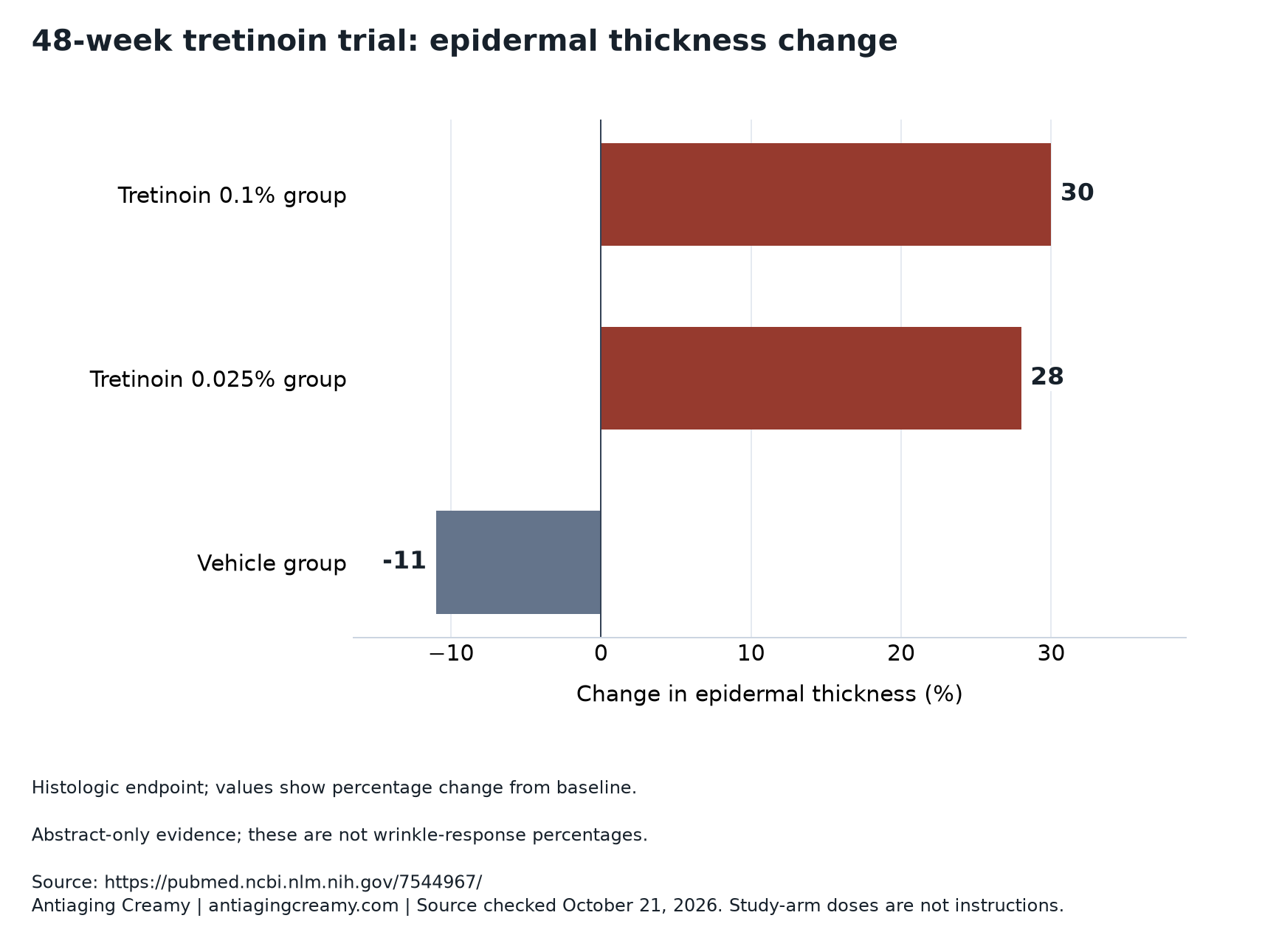
Histologic endpoint; values show percentage change from baseline.
Abstract-only evidence; these are not wrinkle-response percentages.
Download source-labeled chart (PNG)Download chart data (CSV)Download vector chart (SVG)
| Study group | Reported value |
|---|---|
| Tretinoin 0.1% group | 30 |
| Tretinoin 0.025% group | 28 |
| Vehicle group | -11 |
Sections in this article
Start with the outcome hidden inside the claim
Imagine a proposed study of a cream described as restoring skin resilience. The research team would first need to define resilience in observable terms. A symptom questionnaire, an assessor rating and a count of skin injuries would each produce a different answer. Choosing one because it is easier to collect does not make it a substitute for the others. A useful protocol states the intended outcome before collecting results, including who measures it, how often, and what would constitute improvement.
The table separates three possible questions rather than ranking them. Appearance can be a legitimate goal in its own right; it does not need a medical benefit attached to make it meaningful. Conversely, a claim about protection from injury needs direct investigation of injury. The tretinoin and retinol comparison is useful for identifying the intervention being discussed, but identifying an ingredient and defining an outcome remain separate steps. A precise claim should survive both checks without changing its meaning halfway through the explanation.
| Claim under examination | Observation to specify | Conclusion requiring more evidence |
|---|---|---|
| A visible feature improves | A defined rating with consistent viewing conditions | Improved comfort or fewer injuries |
| A tissue property changes | A named laboratory measurement and its units | A visible difference or a functional benefit |
| Daily skin health improves | A defined symptom, activity or event reported over time | A lasting benefit beyond the observation period |
Locate the population before interpreting the comparison
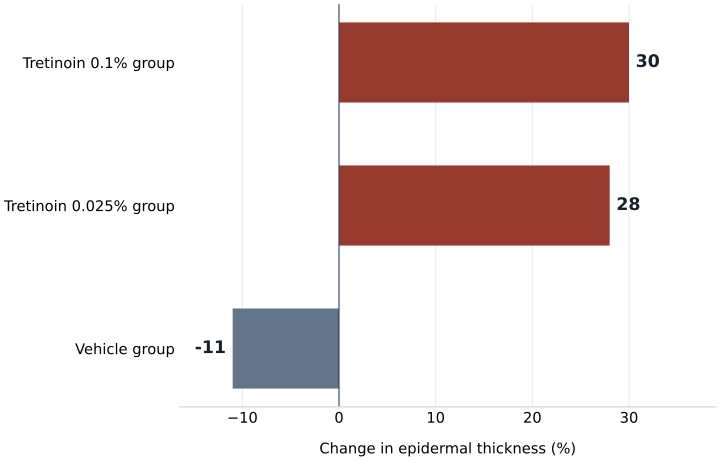
The 1995 indexed abstract describes 99 completers with photoaging: 32 used topical 0.1% tretinoin cream, 35 used 0.025%, and 32 used vehicle for 48 weeks, with double blinding. Both active groups improved clinically versus vehicle; their observed efficacy was similar. The higher concentration produced more erythema and scaling. The abstract does not establish initial enrollment, allocation method, attrition or confidence intervals. Tissue results appear in the accompanying chart.
A completer count answers how many people reached the observation point. To evaluate selection into that group, a reader also needs the flow from eligibility through follow-up. If participants leave a hypothetical study because they dislike a treatment, an analysis restricted to those who remain could describe an unusually tolerant group. If departures are unrelated to treatment, the effect on interpretation could differ. These possibilities are reasons to request the participant flow, not explanations of what happened here.
Double blinding describes concealment of treatment identity during the study. It does not, by itself, specify the method used to assign treatments. Keeping those design features separate prevents a reassuring label from answering a question it was never intended to address.
Read tissue percentages without converting them into wrinkle claims
A percentage is incomplete until its denominator and measurement are named. Consider an entirely hypothetical microscope reading that moves from 80 units to 100 units. The absolute change is 20 units; the relative increase is 25% because 20 is divided by 80. That arithmetic says nothing about how many participants notice a change. Nor does it say that the skin has become 25% younger. Those statements introduce outcomes that were never part of the calculation.
Now suppose a second illustrative group begins at 120 units and reaches 144. Its absolute increase is larger, at 24 units, while its relative increase is smaller, at 20%. Comparing percentages without the underlying measurements could reverse the impression created by comparing absolute changes. These invented values are a lesson in denominators, not reconstructed trial data.
A further question is whether a result summarizes changes within each participant or compares group summaries. Those calculations need not coincide. The correct interpretation follows the reported statistical method; a missing description cannot be replaced by a convenient assumption. This is why the figure retains the original type of measurement instead of translating its bars into a cosmetic success rate.
Ask what a change in a visible rating would mean
An assessor rating puts an ordered description into a score. Its usefulness depends on what the categories mean and how consistently observers apply them. A one-category difference might be easy to recognize under standardized conditions yet difficult to notice in ordinary lighting. Equally, a small change could matter greatly to an individual. An investigator and a participant can therefore answer different, legitimate questions about the same skin.
Consider an invented scale used solely for illustration. A score changes from 7 to 5, giving a two-point improvement. Dividing two by seven produces about 29%, but that calculation does not establish a 29% reduction in visible wrinkles. The categories may not represent equal amounts of physical wrinkling, and the scale may have no meaningful ratio interpretation. Reporting the point change preserves what was actually measured.
A proposed trial could pair blinded assessments with a participant-defined improvement question, specified before results are known. Agreement would strengthen the interpretation that a measured difference is noticeable and valued. Disagreement would deserve explanation rather than selective reporting. Neither measure should quietly replace the other after the data have been collected.
Separate a similar result from a demonstrated equivalence
To establish that two interventions are sufficiently alike, researchers must first define how different they could be while still counting as acceptably similar. That boundary is an equivalence margin. It should have a clinical rationale and be chosen before examining the result. Otherwise, a boundary could simply be widened until the study fits inside it.
Here is a hypothetical example unrelated to the trial estimates. Suppose a difference in improvement is 0.2 points and its confidence interval runs from −1.1 to 1.5. If an independently justified equivalence range were −0.5 to 0.5, that interval would extend well outside it. The small central estimate would not establish equivalence. A narrower interval from −0.2 to 0.4 would answer the margin question differently, assuming an appropriate study design and analysis.
A conventional test for a difference asks a different question. Failure to detect a difference may reflect closeness, imprecision, or both. This distinction matters when choosing the wording of a headline: observations can support further investigation without establishing interchangeability. The guide to prescription and compounded labels addresses a related documentation problem, where similar names should not be allowed to stand in for a demonstrated product match.
Treat irritation as an outcome and a possible source of bias
A study can ask whether an intervention changes appearance and separately ask what burdens accompany that change. Combining those questions into a single enthusiastic description prevents readers from weighing them. A useful tolerability assessment records severity, duration, interruption, and the effect on ordinary activities. Counting any symptom once gives different information from recording repeated difficult days. Neither should be presented as the other.
Irritation can also complicate blinding. In a hypothetical trial, a recognizable reaction might lead an assessor or participant to guess the treatment. That possibility would not automatically invalidate the results, but it would justify examining how ratings were obtained and whether treatment guesses were assessed. Objective measurements and independent assessments can answer different aspects of that concern.
Finally, two changes occurring together do not show that one caused the other. Demonstrating a mechanism would require evidence that distinguishes competing explanations, ideally with measurements taken in a sequence capable of testing the proposed pathway. A contrast between treatment groups can motivate that investigation without proving a universal rule about whether a reaction is necessary for benefit. Symptoms should never become a self-directed target for experimentation.
Demand a direct bridge from laboratory change to skin function
The 2007 retinol paper studied 36 people averaging 87, comparing 0.4% lotion with vehicle on upper inner arms over 24 weeks; 23 completed follow-up. Fine-wrinkle improvement favored retinol. Selected biopsy assays involved only four or six participants. The authors proposed protection against injury and ulcers, rather than measuring those outcomes. Three participants withdrew because of irritation or pruritus.
This distinction motivates a prospective design rather than a stronger retrospective claim. A future study of injury protection would need an explicit event definition, consistent surveillance, and enough observation to distinguish a treatment effect from chance. It would also need to account for factors affecting exposure to injury. A favorable laboratory change could be investigated as an intermediate step, while the clinically relevant event remains separately measured.
A proposed connection becomes more persuasive when multiple measurements agree in the same participants, the sequence fits the hypothesis, and alternative explanations are examined. Even then, association alone does not establish that the intermediate measurement caused the clinical result. Our close reading of the retinol arm-skin study examines that evidence in detail. It is a different scientific question from choosing between facial tretinoin concentrations.
Let longer follow-up answer a defined question
A 2005 randomized trial followed 204 participants using 0.05% tretinoin emollient cream or vehicle for up to two years. Its abstract reports improved clinical photodamage measures and a month-12 procollagen marker, but no numerical clinical effect sizes or confidence intervals. It reports no increase in specified microscopic abnormalities; that is not evidence of cancer prevention.
Duration describes the observation window. To interpret persistence, a reader would also want results at successive visits, the people assessed at each visit, and the treatment exposure over that period. A final observation alone cannot reveal whether change accumulated steadily, plateaued early, or fluctuated. A longer window can also reveal burdens that a short study could miss, provided those burdens are actively measured.
The distinction between an on-treatment result and a result after treatment ends is equally important. These are different questions requiring different follow-up schedules. A proposed study could predefine both, while reporting how many participants contribute to each estimate. The table below shows what evidence would match a broader promise. It does not assert that the published studies performed these additional analyses.
| Proposed claim | Evidence needed | Interpretive safeguard |
|---|---|---|
| The benefit remains stable | Repeated estimates with uncertainty and follow-up counts | Do not infer a trajectory from the final visit |
| The benefit lasts after treatment | A defined observation period after exposure ends | Separate continuing treatment from post-treatment follow-up |
| The treatment protects skin health | Directly measured symptoms or clinical events | Do not substitute a tissue marker for the claimed outcome |
Preserve the exact meaning of a product label
Current RENOVA 0.02% labeling concerns mitigation of fine facial wrinkles alongside skin care and sunlight avoidance. It does not establish reversal of photoaging, use beyond 52 weeks or use above age 71. It warns against use during pregnancy or when attempting pregnancy, and describes local irritation. This is a particular formulation, not an approval of every tretinoin product.
The scientific match should be documented before carrying a conclusion across to a purchasable product. A useful comparison records the formulation, route, treated site, intended outcome, and supporting study. Matching one element leaves the others unresolved. Two percentages cannot establish that the cream base, accompanying ingredients or actual exposure are equivalent. The comparison is a documentation exercise, not a request to experiment with strengths.
Our editorial interpretation for readers comparing services is to separate the evidence question from the transaction. The Musely anti-aging cream review and Curology HydroTret review are places to check documented terms and product descriptions. Those links do not attribute the research results to either provider. Questions about personal suitability belong in an individual clinical discussion, where the exact proposed product and medical history can be considered together.
Build a conclusion that another reader can audit
A clear evidence dossier preserves the route from question to conclusion: the outcome definition, measurement method, comparator, participants, observation window and uncertainty. It should also distinguish a planned analysis from an exploratory one. A favorable exploratory result can suggest a useful next study, but it should not be presented with the same confidence as a prespecified primary test merely because its number is striking.
Financial relationships belong in that dossier. Four retinol investigators disclosed an invention-related entitlement to royalties if licensing and product sales occurred. That disclosure does not establish a payment. The two tretinoin abstracts do not identify funding. A disclosed interest is relevant context, not a calculation that can be used to add or subtract points from an effect estimate. Methods, completeness and independent replication still require examination.
Our editorial interpretation is to write the narrowest claim that preserves the finding, then state the next question separately. For a purchasing decision, comparing skincare costs adds another necessary record: what is actually being paid for. Price cannot turn a laboratory result into a clinical endpoint. A careful comparison keeps scientific meaning, individual priorities and contractual terms visible without pretending that any one of them resolves the others.
Questions about the evidence
Can a large tissue change be clinically unimportant?
It is possible in principle because a measurement and its practical meaning are different questions. A future study would need to connect the tissue finding to a prespecified outcome someone notices or values. Without that bridge, the measurement remains informative about its own endpoint; its size does not supply the missing clinical interpretation.
How should I compare two studies using different rating scales?
Start by identifying what each scale measures and how its categories are defined. Equal numerical changes on different scales need not represent equal effects. A defensible comparison requires a justified common interpretation, comparable populations and appropriate methods. Simply dividing each change by the highest possible score does not resolve those differences.
Why not combine appearance and irritation into one score?
A combined score would require an explicit weighting rule: how much discomfort offsets how much visible improvement, and according to whom? Different people may reasonably choose different weights. Reporting both outcomes separately preserves the information needed for that discussion. Any combined measure should explain its construction rather than conceal the tradeoff inside a single number.
Does a biological explanation make a broader claim credible?
A plausible explanation can guide research, but a broader claim still needs evidence at the level it promises. To claim fewer injuries, investigators should measure injuries. To claim improved daily comfort, they should measure comfort. A mechanistic story is most useful when it generates a testable prediction, including observations that could show the explanation is wrong.
What would make the next study more useful to readers?
A clearly defined question, justified thresholds for meaningful change, complete participant flow, and outcomes that reflect both benefit and burden would improve interpretability. Publishing uncertainty and unfavorable findings matters as much as presenting favorable estimates. The resulting report should allow someone to understand who was studied and exactly which decision the evidence can inform.
Editorial assessment
These studies are useful when their measurements retain their original meaning. The editorial task is to identify the outcome, preserve its units, and examine the strength of the connection between that outcome and the claim under consideration. A tissue result can motivate a clinical hypothesis; a visible rating can document appearance; a patient-important outcome can address a lived concern. Combining those ideas requires evidence, not a change in vocabulary. For a reader weighing an antiaging claim, the most productive question is therefore specific: what observation would show that this particular promise has been fulfilled?
Research access and limitations
This analysis uses the indexed abstracts for the two tretinoin trials, the full publisher retinol article and current official RENOVA labeling. It does not represent review of all protocols, supplements or individual participant data. Numerical teaching examples and prospective study frameworks are original illustrations, not reconstructed findings or treatment instructions.
Sources and access notes
Sources checked October 21, 2026. Access notes identify the material examined for this article.
- Two concentrations of topical tretinoin (retinoic acid) cause similar improvement of photoaging but different degrees of irritation. A double-blind, vehicle-controlled comparison of 0.1% and 0.025% tretinoin creams.
Indexed original research abstract · Checked October 21, 2026
- Improvement of naturally aged skin with vitamin A (retinol).
Full publisher research article, including original clinical table-image footnote, figure captions, Comment and Financial Disclosure; no supplements or individual data reviewed. · Checked October 21, 2026
- Long-term efficacy and safety of tretinoin emollient cream 0.05% in the treatment of photodamaged facial skin: a two-year, randomized, placebo-controlled trial.
Indexed original research abstract · Checked October 21, 2026
- DailyMed - RENOVA- tretinoin cream
Official current labeling retrieved in full · Checked October 21, 2026